Drying Rack vs Tumble Dryer After the EU's New Energy Label: What Each One Really Costs

18 August 2026 · Explainer
Since 1 July 2025 only heat-pump tumble dryers may be placed on the EU market, and the label now runs A to G with consumption stated per 100 cycles. Read against Eurostat's 2026 electricity figures, the running-cost gap is narrower than the internet claims. Here is the honest case for a drying rack, which type suits which home, and how to use one without creating a damp problem.
What changed for tumble dryers on 1 July 2025
Two measures the European Commission announced together in November 2023 took effect on the same day, 1 July 2025: Commission Regulation (EU) 2023/2533 sets the ecodesign requirements for household tumble dryers, and Commission Delegated Regulation (EU) 2023/2534 sets the energy label. The label was re-scaled from the old A+++ to D range to a plain A to G range, with the A class reserved for best-in-class performers, and it now carries a QR code that opens the appliance's entry in the European product registry. The heavier change sits in the ecodesign rules: the Commission states that from that date only tumble dryers featuring the most efficient heat pump technology are allowed on the Union market. Vented and condenser machines, long the cheap end of the shelf, no longer clear the bar in any EU country. The Commission puts the expected effect at cumulative savings of 15 TWh and 1.7 million tonnes of CO2 equivalent by 2040, worth some 2.8 billion euro off consumers' energy bills. From 2027 the label will also carry a reparability score.
What a drying cycle costs at 2026 electricity prices
The new label states weighted energy consumption per 100 cycles, which makes the arithmetic unusually easy. Topten, the efficiency-listing project run by the Topten International Group in partnership with WWF and the European Commission, currently lists label-leading household models between 73 and 84 kWh per 100 cycles, from an Electrolux EW9D787KCE at 73 kWh to a Hisense DH5I104BWAB at 84 kWh, and assumes 100 drying cycles a year in its lifetime-cost model. Eurostat, publishing in May 2026, put the average household electricity price in the EU at 0.2896 euro per kWh in the second half of 2025, essentially flat against the first half. Multiply the two and a year of machine drying on those models costs roughly 21 to 24 euro in electricity. Where you live moves that number far more than which model you buy: at Ireland's 0.4042 euro per kWh, the highest household price in the EU, the same 100 cycles cost about 30 to 34 euro; at Hungary's 0.1082 euro, the lowest, under 10 euro.
So what is a drying rack actually for?
If the honest figure is 21 to 24 euro a year, the usual pitch, that air-drying saves a fortune in electricity, does not survive contact with the label. The real case for a rack lies elsewhere, and it is stronger for being narrower. A heat-pump dryer is a major appliance: a purchase price, a condensate tank to empty or a drain hose to arrange, and a permanent footprint of its own. Eurostat counted 17% of the EU population living in overcrowded homes in 2024, with an average of 1.7 rooms per person, and a great many of those homes simply have nowhere to put a second white good. A rack costs a fraction of one, needs no installation and no dedicated spot, and folds down to the thickness of a door when the laundry is dry. It is also the only option for the garments whose care label rules out tumble drying: wool, elastane-heavy sportswear, and anything that has already shrunk once.
Which rack fits which home
Racks are not interchangeable, and picking the wrong type is why people give up on air-drying. The workhorse is the tiered freestanding rack: three levels of rail let a load hang spread out rather than doubled over itself, and a wheeled frame lets it follow the light round the room and then park behind a door. Its weakness is the footprint while open, so it wants a room that can spare a metre for a day. The second type is the folding multi-tier hanger, which hangs from a rail you already have: five pairs of trousers take up the width of one, which is how a wardrobe rod becomes drying space in a room with no floor to give. The third is a rail rather than a rack, a stainless towel bar fixed with adhesive instead of screws, for the small constant items in a bathroom that already has extraction. Most homes end up using two of the three rather than one.
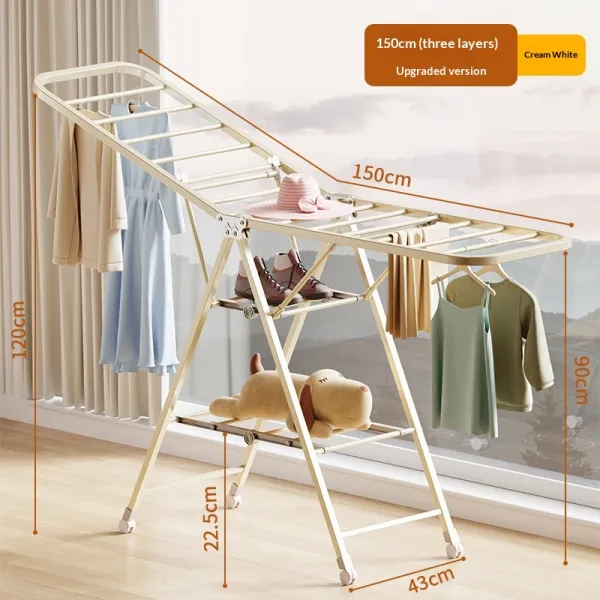
Foldable Rolling Clothes Drying Rack (3-Tier)
Three tiers of drying, rolls away
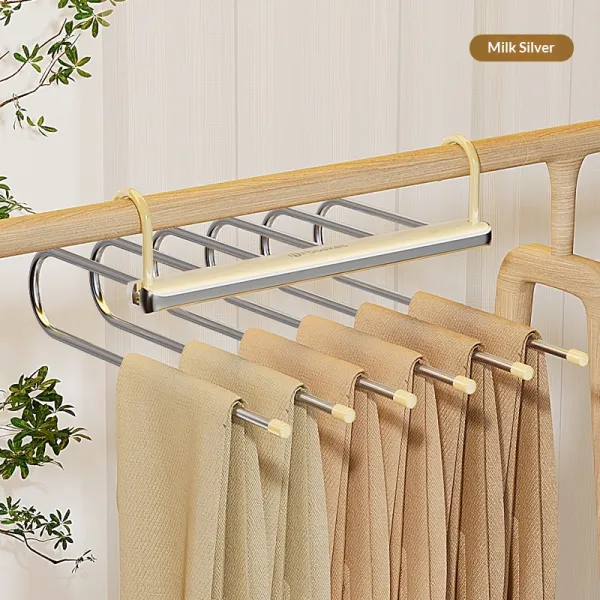
Folding Multi-Tier Pants Hanger Rack
Five pairs of trousers, one hanger
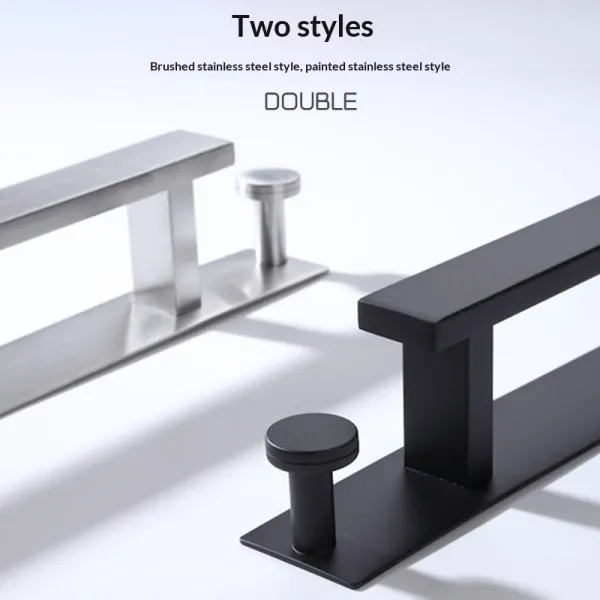
Stainless Steel Towel Rack (No Drilling)
Towel rail without wall damage
The part most rack listings skip: the water has to go somewhere
A tumble dryer condenses the water out of your clothes and sends it to a tank or a drain. A rack does not: all of it evaporates into the room. That is the genuine trade-off, and it is documented rather than folkloric. A 2008-2011 study by the Mackintosh Environmental Architecture Research Unit at the Glasgow School of Art, funded by the EPSRC and published in Indoor and Built Environment, monitored 22 dwellings drawn from a wider survey of 100 homes and concluded that where laundry was dried passively indoors, moisture levels are likely to boost dust mite populations and concentrations of airborne mould spores, a risk the authors tie to increasingly airtight housing. The World Health Organization's 2009 indoor air quality guidelines on dampness and mould are blunt about the remedy: the most important means for avoiding adverse health effects is the prevention, or minimisation, of persistent dampness and microbial growth on interior surfaces and in building structures. In practice: dry in one room rather than spreading loads through the home, open that room's window or run its extractor while the rack is loaded, and keep the rack off the coldest exterior wall, where condensation shows up first.
Where the rack lives the rest of the week
A drying rack is in use perhaps two days in seven, which makes its folded footprint matter as much as its open one. The rack that ends up permanently half-open in a hallway is the one that gets resented and eventually thrown out. Choose a model that collapses flat and give it a nominated gap to live in: behind a door, beside a wardrobe, under a bed. The other half of the job is upstream of the drying. Air-drying works best in batches, and batches need somewhere for laundry to gather that is not the bedroom floor: a lidded hamper if the pile should be out of sight, or an open basket presentable enough to stand in a living space, which is the realistic answer in a home where the machine and the living room are the same room. Get the gathering right and the drying stops being a daily interruption.
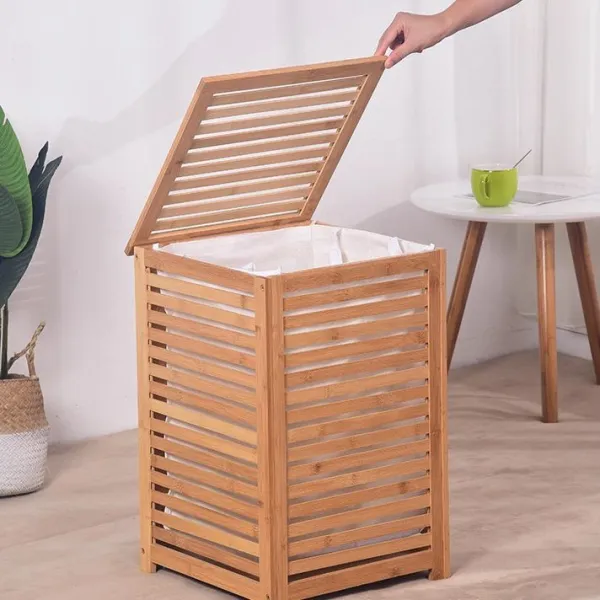
Bamboo Laundry Hamper with Lid & Liner
Laundry hidden under a bamboo lid
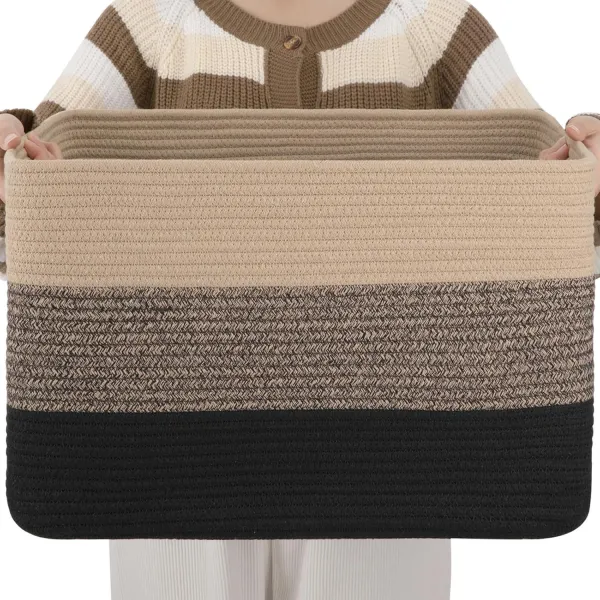
Cotton Rope Laundry Basket
The laundry basket that can stay visible
FAQ
Can you still buy a vented or condenser tumble dryer in the EU?
Not as a new product. Under the ecodesign rules that took effect on 1 July 2025, the European Commission states that only tumble dryers featuring the most efficient heat pump technology are allowed on the Union market. The rules govern what may be placed on the market; appliances already in use in people's homes are not affected.
Is a drying rack really cheaper to run than a modern tumble dryer?
In electricity, yes, because a rack uses none. But the gap has narrowed. On the label-leading heat-pump models listed by Topten, 73 to 84 kWh per 100 cycles works out at roughly 21 to 24 euro at the EU average household price of 0.2896 euro per kWh (Eurostat, second half of 2025), on Topten's assumption of 100 cycles a year. The stronger arguments for a rack are purchase price, floor space, and fabrics that cannot be tumbled at all.
Does drying laundry indoors cause mould?
Not on its own; unventilated drying can contribute. The water in a wet load evaporates into the room, and the WHO's guidance on dampness and mould identifies preventing persistent dampness on interior surfaces as the key measure. Dry in one room, ventilate that room while the rack is loaded, and keep the rack away from cold exterior walls.
Sources
- European Commission — New measures for more energy efficient household tumble dryers (1 July 2025)
- European Commission — Commission announces new ecodesign and energy labelling rules for household tumble dryers (22 November 2023)
- European Commission — Energy-efficient products: tumble dryers
- Eurostat — EU household electricity prices stable in 2025 (5 May 2026)
- Eurostat — Electricity price statistics (Statistics Explained)
- Topten — Selection criteria: tumbler driers (Topten International Group, with WWF and the European Commission)
- Porteous, Sharpe, Menon et al. (2014) — Domestic laundering: environmental audit in Glasgow with emphasis on passive indoor drying and air quality, Indoor and Built Environment 23(3), 373-392
- World Health Organization — WHO guidelines for indoor air quality: dampness and mould (2009)
- Eurostat — Housing in Europe, 2025 edition (interactive publication)